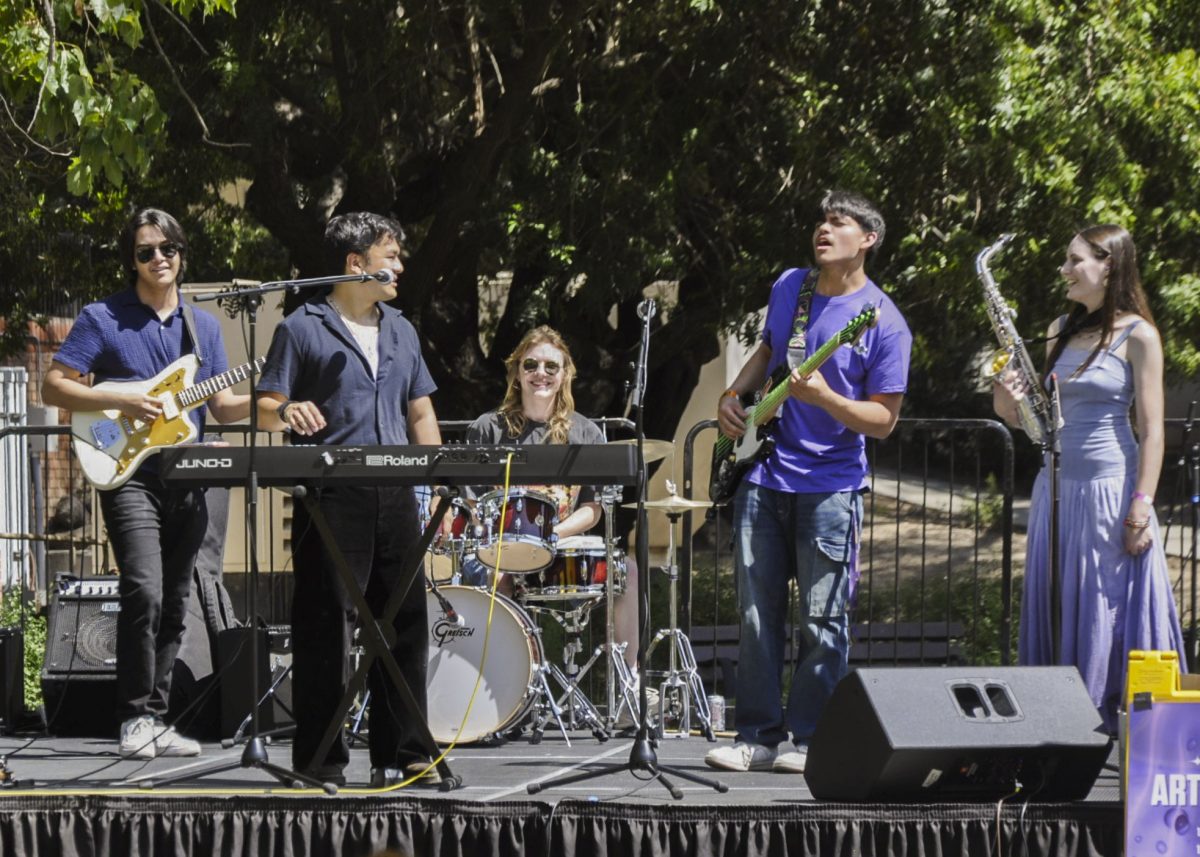

The Center for Cultural Engagement and Inclusion’s annual Asian American and Pacific Islander Night Market returned to California Lutheran University’s campus on Wednesday, April 23, celebrating AAPI heritage with local entrepreneurship and performances in Kingsmen Park.
Three Cal Lutheran student organizations—Club India, FILO Club and Kupa’a Hawai’i Club—joined the CCEI in tabling the event in anticipation of AAPI Heritage Month in May. Attendees were provided a meal from Rice Balls of Fire, a Korean-fusion food truck.
“To have days like this, and celebrations like this, where everybody is so excited to know more about your culture, you feel seen,” said Avya Pandhi, a junior international student and president of Club India.
Pandhi was a vendor at the night market, selling handcrafted bags, brooches and nazar rings that were flown in from her mother’s business called SEVGI, which is based in India. Pandhi said her items were handmade by an all-women team impacted by domestic abuse.
“She ended up hiring a team of women, all survivors, and they all hand-make every single bag and a piece of jewelry that you see, and my mom single-handedly sells it all,” Pandhi said.
Pandhi said she was proud of the reception her mother’s business received from attendees, as she told customers about traditional Rajasthani embroidery and the stories behind each bag.
“The texture is really important for every single item that you use, like mirrors and beads. All the women, they actually get to pick their own color schemes and styles that they want to do. That’s why they’re all different,” Pandhi said.
Club India also hosted a spin-the-wheel trivia game at their booth, where attendees could test their knowledge of Indian culture, from geography to historic figures, to win candy. Club India member Sanket Jadhav said providing an understanding of phrases like “namaste” beyond the clichés of Indian culture, was a cool experience.
“When they say what the literal meaning of ‘namaste’ is, most people would say, you know, it’s ‘peace’ or it’s just ‘hello.’ But then there’s a deeper meaning, which is like, you know, ‘I bow to the divine in you.’ There’s just stuff like that that people have been getting to learn about, which has been a great thing,” Jadhav said.
FILO Club also hosted an information booth, sold donuts, and took the dance floor for a traditional Filipino martial arts performance called Kali.
Senior Noeloni Ramiscalco-president of the FILO Club, helped choreograph the Kali routine with assistance from Tae Ryong Taekwondo. Ramiscal said she prepared to lead rehearsals by watching videos of Kali being taught in the Philippines.
“I was actually inspired by the Philippines curriculum. They’re taught Kali in PE One of their assignments is to do synchronized Kali, or they call it ‘Arnis’ and ‘Escrima,’ just depending on the region,” Ramiscal said.
According to Ramiscal, all ages and skill levels can learn Kali. Ramiscal said the FILO Club hosted a demonstration with Tae Ryong Taekwondo on campus to help teach the hand-to-hand combat and stick fighting routine to club members before their performance.
“The way that the instructor taught it was that he’s giving us, like, an arsenal of weapons to use into a freestyle battle, so that’s kind of like the mindset I had. I wanted to give them all the different moves, and then after that, we’ll put it into a choreographed routine,” Ramiscal said.
The eight performers wore an all-black ensemble with red bandanas— an ode to Tae Ryong Taekwondo’s studio uniform. Ramiscal said she was very happy with the club’s performance and that it was their best run-through yet.
After their Kali routine, FILO Club members invited attendees to the dance floor to participate in Tinikling, a traditional dance of the Philippines. Jayden Baltazar, a sophomore performer from the FILO club, said seeing other students participate in their Tinikling workshop was incredible.
“It’s a surreal feeling. I feel like being able to share part of my culture and to see a bunch of people here that are willing to learn and be curious, … I think it’s an awesome thing to feel,” Baltazar said.
Attendees were able to take home a lei courtesy of Kupa’a Hawai’i Club from their lei-making booth. Club officers assisted attendees with the traditional process of threading needles through orchid flowers.
Senior Julian Akaka, a Kupa’a Hawai’i Club officer, said seeing the positive reception from students surprised him, and that the support brought him a small taste of home.
“People actually want to make lei, and that means a lot, coming from somewhere where you see lei everywhere, and up here, you don’t really see it that much,” Akaka said.
As a first-time AAPI Night Market attendee, junior Lauren Claire Avelino said working at the FILO Club booth and speaking to students about her Filipino pride was a highlight for her.
“Being a transfer here, this being my first year, it’s so diverse and I’m just so happy that I’m able to, you know, help them during their cultural events. I’m just glad that Cal Lutheran is a place where, at least for us Filipinos, we can express who we are,” Avelino said.