
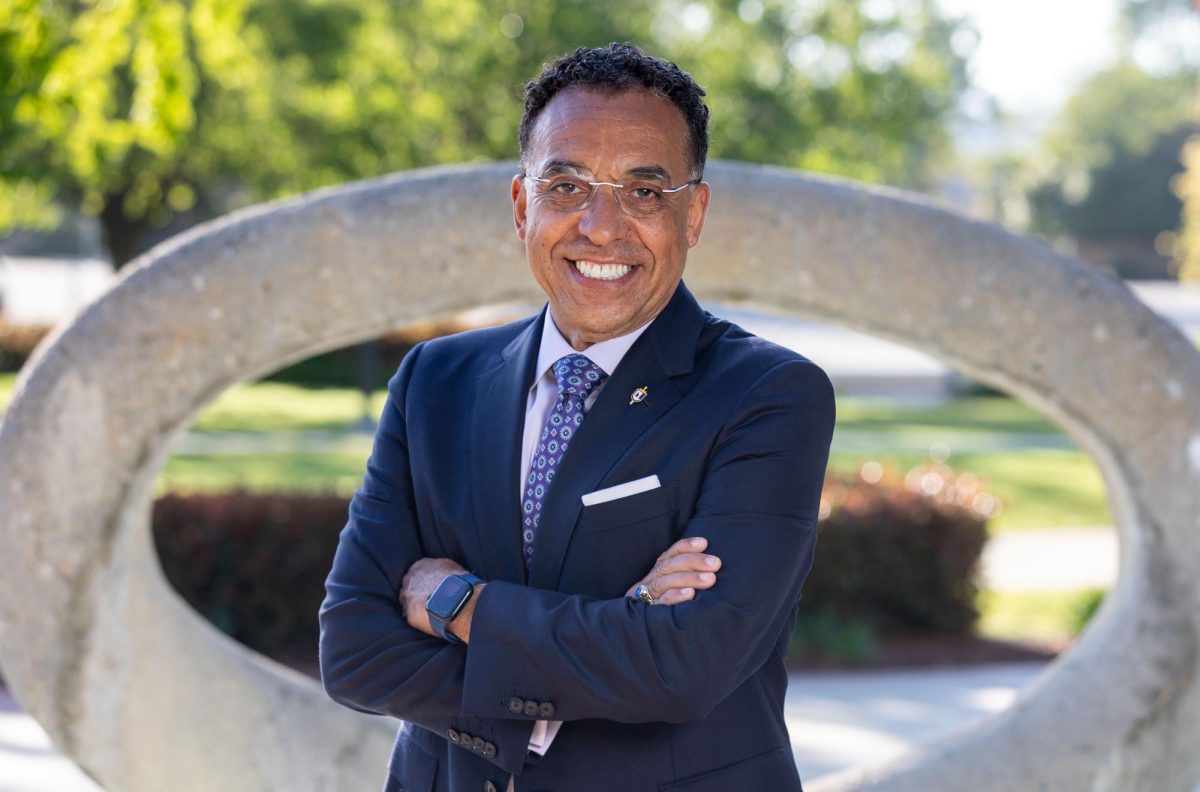
In August, President John Nunes welcomed his inaugural class of students after having his interim tag removed to become California Lutheran University’s ninth president. Facing an immediate “urgency” to navigate the university’s budgetary challenges—a $28 million deficit over the last four years, Nunes said—he spent the summer making what he called “hard decisions” before having to make “heartbreaking decisions.”
Following news of his appointment on June 1, Nunes announced a series of organizational changes internally, including faculty and staff changes and building relocations. Nunes said his broader mission for the school year is redefining Cal Lutheran’s “why,” which he says will fuel student recruiting, anchor the case for fundraising, and strengthen alumni and community engagement.
“We believe that the mission is too important to let fail. We have a unique place in higher education as a Christian institution that is committed to communities of marginalization and minoritization,” Nunes said. “We have something special to say in the world, and we want to keep saying it. We don’t want to close.”
Nunes said if the university’s expenses keep exceeding its revenue annually by millions of dollars, “by about three or four years down the road, we’d be closed.” In an interview with The Echo, Nunes illustrated the university’s plan over the next few fiscal years to combat a potential closure.
Nunes presented a spectrum with two extremities: university closure on the left, and a “balanced budget”—when spending and revenue are equal—on the right, said the balance to preserve a “viable” university falls somewhere in the middle.
“If I go too far [toward balancing the budget], that’s going to impact the student experience. If I don’t go far enough, it’s going to impact the future,” Nunes said.
According to census data from the Cal Lutheran website, total new traditional undergraduate enrollment has decreased about 27% since 2022. Provost and Vice President for Academic Affairs Leanne Neilson said “prolonged student decline” in enrollment and “out of balance” student-to-faculty ratios have played a role in recent faculty changes.
Two non-tenure track faculty members out of 166 total full-time faculty were not renewed for the 2025-26 school year, a response to enrollment decline within the particular departments over the last decade, Neilson said. The number of adjunct faculty departures was not disclosed by Neilson, as they are appointed on a term-by-term basis with no commitment to ongoing employment, according to the faculty handbook. Neilson said she preferred not to comment on which academic departments were affected by the departures.
Additionally, two tenured faculty were not renewed for the year, in a decision Neilson called “abnormal.” According to the faculty handbook, “non-tenured faculty members in a department will be released before tenured faculty members, except in circumstances where a serious distortion in the academic program would result.”
“We’ve been fully transparent and communicating about [the faculty changes],” Neilson said. “Nobody likes to see their colleagues, you know, leaving, but I think people understand. If student interest drops, then we don’t need as many people to be teaching in the area.”
Sharon Docter, faculty representative to the Board of Regents, said she believes the student experience will not be affected by these recent university staff changes.
“Despite the challenges facing higher education today, I believe that the faculty at Cal Lutheran as well as the broader administration are committed to making sure that every student has a high quality and impactful academic experience,” Docter said in an email interview. “Opportunities like [travel seminars, experiential learning, research opportunities] and many others will remain in place, despite the budget challenges that we are facing.”
In light of decreased student interest, Nunes said a search is underway for a new senior vice president who will now oversee University Advancement, fundraising and enrollment. The new position will be based on responsibilities previously held by Matt Ward, whose role as vice president for enrollment management and student success will be “reimagined.” Ward’s service at Cal Lutheran concluded in May.
“We’re not raising enough money and we’re not recruiting enough students, and we want to improve that. Therefore, we’re going to reimagine that whole area,” Nunes said.
Nunes said he hopes to hire a candidate with experience outside higher education who can bring an understanding of the digital world to the university’s marketing efforts.
Additionally, a yearlong search for a new dean of the College of Arts and Sciences began last week, following the retirement of former Dean Tim Hengst in May. The search will be conducted by a search committee led by Faculty Senate Chair Kristine Butcher, Neilson said.
The decision follows Neilson’s initial announcement to faculty in March, which stated the position would not be filled following a months-long search. In the same faculty assembly meeting, Neilson said the responsibilities of the dean were going to be delegated amongst herself and other administrators. The announcement was met with “disappointment” from faculty and created concern about Neilson’s plan to handle the responsibilities of provost and dean.
As the search continues, four associate deans, each in charge of humanities, social and behavioral sciences, natural science and creative arts divisions of the college, have received increased responsibilities, some of which will continue after Hengst’s successor is appointed, Neilson said. She said she is excited that this redistribution will allow the new dean to perform more external work.
“We’re looking to expand the responsibilities of the new dean,” Neilson said. “We’re really putting an effort in here at Cal Lutheran to do more collaborations and partnerships off campus. We want to connect more with businesses, with government, with nonprofits, so that we can do things like develop internships for students.”
At a town hall hosted in May, Nunes announced a series of relocations as part of ongoing efforts to minimize the university’s debt. He said that by “selling parts of the campus to pay the bills” and assessing vacant campus spaces available for rent, Cal Lutheran can generate revenue.
Neilson worked with associate deans to conduct this assessment, analyzing floor plans of vacant offices and uniting similar departments to gauge how to most efficiently use campus space while not negatively impacting student experience. Ultimately, the process resulted in 44 faculty and staff relocations over three weeks—a “really successful” process, Neilson said.
Additionally, Nunes said there are plans to centralize Cal Lutheran’s Oxnard and Westlake Village satellite campus operations to the main Thousand Oaks campus following the 2025-26 school year. Both campuses house Community Counseling Centers for the Graduate School of Psychology, among other facilities that serve students in the area.
Neilson said the new commute for satellite campus students is “not convenient,” but that the university is in talks with Residence Life to make room for more housing specifically for those affected.
The most recent consolidation effort for Cal Lutheran is Student Central, a new hub located across from Career Services, where the Center for Global Engagement used to be housed.
According to an email from Ryan Van Ommeren, associate vice president of Planning and Services, the “one-stop-shop,” combines the offices of Academic Services, Student Accounts and Financial Aid under one roof.
Neilson said it will provide a convenient space for students to be able to have all of their questions answered without having to walk across campus to three different buildings. Neilson also said decisions like these have the best interest of the university in mind.
“We are putting the structure in place to rebuild. I feel extremely positive about the future, and I feel very positive about President Nunes [and] his leadership. We’re going in the right direction for sure,” Neilson said.
Butcher also said although universities across the country are experiencing “very difficult times,” she remains confident in Cal Lutheran faculty’s ability to stay focused on serving their students.
“Difficult times sometimes bring difficult decisions. But in spite of these difficult times, there are great things happening at the university. The faculty are intent on keeping focus on the student experience,” Butcher said.
After what he described as his “365-day interview,” Nunes will be officially inaugurated during Homecoming Weekend on Oct. 17.
While Nunes said he has already made multiple “hard decisions” in his tenure as president, he believes “the pain will be worth it, because [Cal Lutheran’s] mission is worth the pain to endure.”
“I couldn’t be happier on the one hand, but let’s celebrate in October… at the inauguration, and then let’s celebrate in a couple years when we get some of these problems fixed,” Nunes said. “For now, we’ve got work to do; and some of it is not easy and some of it is painful and necessary for the sake of the continuity and perpetuity of our mission into the future.”


![“We heard [the students], and we’re going to try to offer something that still has their favorites, but also introduce something new at a point where people feel like they’re willing to pay,” Elizabeth Nepute said.](https://cluecho.com/wp-content/uploads/2026/04/IMG_9502-1200x800.jpg)


