
California Lutheran University’s Office of Research hosted its annual Student Research Symposium on Saturday, Oct. 18, showcasing undergraduate research from students across various disciplines.
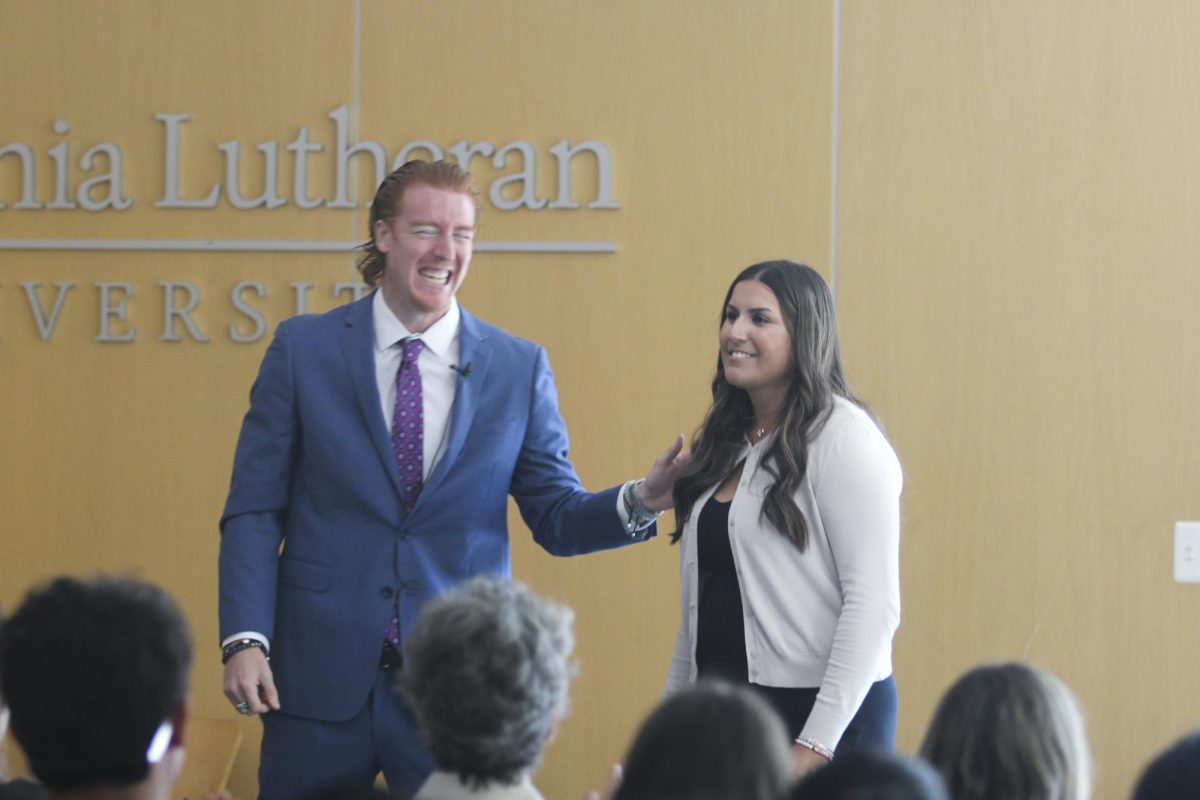
Leanne Neilson, provost and vice president for Academic Affairs, and Andrea Sell, director of Research Development and Support, awarded students Angela Abalo, Nevign Angelique Besas and Carys Garvey for excellence in their summer research programs.
In addition, Neilson and Sell awarded Criminology and Criminal Justice lecturer Andrew Madrigal for excellence in mentoring his undergraduate research student Ashlyn Bryson-Beane.
“As a relatively new faculty member and first-time research mentor, Dr. Madrigal has done an exceptional job guiding his student through complex, qualitative research, modeling rigorous data practices, and research procedures,” Neilson said. “He consistently shows up to support his student and colleagues, attending events, and offering guidance beyond what is required. His commitment, accessibility and genuine investment in his student’s success, make him an exemplary mentor.”
Senior Ninelihle Dube said she did her research project on transnational motherhood with Zimbabwean mothers. She said she is looking at mothers who leave Zimbabwe and their children behind to go to South Africa to pursue domestic work.
Dube said she grew up in Zimbabwe and is familiar with how domestic work affects children who are left behind.
“I have friends and family who have left [to] South Africa and children who have been left behind. So I kind of have a little, like, insight on how all that works. And I’ve seen how it affects most of the children,” Dube said.
Dube said this research has made her more aware of the situation in Zimbabwe and how it is “not normal.” She said mothers leaving Zimbabwe isn’t necessarily a “bad thing,” as they are finding South Africa as a place to grow their community and economy.
“I grew up with this, but then I’ve learned more from it than what I thought I knew and some things have changed how I feel [about] the whole situation,” Dube said. “Not a lot of scholars will get this [situation] … especially Zimbabwe scholars, because to us, it’s been normalized. When you start writing about it and actually bringing it out to the world, that’s when people start saying, ‘Oh, yes, this is part of, like ,our culture,’ and we haven’t really actually looked at how it affects children.”
Lorena Muñoz, associate dean of Equity, Inclusion and Belonging and associate professor and director of Ethnic and Race Studies and Global Studies, is Dube’s faculty mentor. Muñoz said in an email interview that she, Dube and Zimbabwean professor Thulie Zikhali are working together for the research project.
“We meet weekly and go through the process of coding, analyzing data and writing our analysis to write and submit the article for publication to a peer-reviewed academic journal,” Muñoz said.
Muñoz said conducting research helps students “narrow down” different professional and career paths.
“Before you commit to a particular profession as a first-year, it is great to experience through active learning (research) and professional experiences (internships) to know and discover the student’s passion. Undergraduate research helps students discover that,” Muñoz said.
Muñoz said she believes that undergraduate students should experience summer research.
“I believe ALL students should have the opportunity to experience summer undergraduate research,” Muñoz said. “It does not matter what your field is, either STEM, humanities, social sciences, experiential learning, active learning are high-impact experiences that develop skills needed in any career they might choose or of course graduate school.”
Senior Katherine Curtis said she conducted her research project on the impact of the U.S. Supreme Court’s June 2022 ruling in the case Dobbs v. Jackson Women’s Health Organization on public opinion alongside her faculty mentor Haco Hoang, professor of political science.
“We’re looking at how it’s affected voter turnout and mobilization, especially among young adults and women and minorities who tend to be the most greatly impacted by abortion policies,” Curtis said.
Curtis said researching the decision was interesting to her as she remembers the event happening when she was in high school.
“I remember I was a senior in high school when the initial leak of the Dobbs decision came out,” Curtis said. “It’s really been interesting to analyze and see all the different perspectives and the impact of it.”
Curtis said she can apply this research for a future career in public policy and government.
“While our research is more focused on public opinion, I think that one of the things that we’ve been looking at is how public opinion often shapes political behavior, which then shapes policy,” Curtis said. “I think that there’s a lot of applications to it, like learning this relationship between opinion and then how that shapes policy.”
Hoang said in an email interview that Curtis has been working on the research project for two years and they both work “very closely” to collect and analyze data related to the impact of abortion on recent elections.
Hoang said a highlight she remembers was when she and her research students presented the Dobbs v. Jackson project at a panel.
“Last year, three of my research students and I presented the Dobbs project at the Western Political Science Association. They each presented a section of the project, and the panel was other faculty not students and they did an excellent job. The other panelists and academics in the audience were impressed that undergraduates could produce and present such high quality research,” Hoang said.
Hoang said she tells her students that doing research is an example of “doing political science” and it helps students approach “real-world problems.”
“I tell my students that ‘Political Science is a contact sport’ because we want students to ‘do’ not just ‘think’ about politics and policy. Research is a prime example of ‘doing Political Science,’” Hoang said. “Research also allows students to apply their academic skills to understand and address real-world problems like representation, reproductive rights and political engagement.”