
California Lutheran University will launch an esports program in fall 2026 as a means to increase revenue and student enrollment, as announced by Leanne Neilson, provost and vice president for Academic Services, at an Oct. 28 Town Hall meeting.
President John Nunes said the program came from repeated student interest, not campus leadership.
“The notion or the creative impulse for an esports program at California Lutheran University did not originate with me,” Nunes said. “I have heard from students over and over again that this is one of the emerging activities that they find beneficial, constructive and enjoyable.”
Neilson, Howard Davis, director of Athletics, and Laureen Hill, executive partner for strategic planning and business development, are currently in charge of spearheading the effort, according to Chief Information Officer Zareh Marselian. He said one of the first steps will be to hire a team manager, with responsibilities including operations management and coaching.
Neilson will take charge of relevant academic programs the university plans to introduce in conjunction with the esports program, Marselian said.
The initial plan, Marselian said, is to implement an esports emphasis within the sports management program, with the aim it bleeds into other disciplines like psychology and visual arts.
“My hope is that, organically, [esports] will grow into other disciplines,” Marselian said. “There could be a host of tie-ins to other academic programs.”
Davis will manage the operations of an eventual esports arena on campus, while Hill will lead the workgroup tasked with the program’s feasibility and logistics for preparing an esports organization, Marselian said.
Marselian said further conversations with student leadership will need to take place before a location for an esports facility is finalized, but that it will likely be built inside the currently dormant D building or Nygreen Hall.
“We are looking at sunsetting two buildings, Nygreen and D building,” Marselian said. “We are looking into options to extend the project to include Nygreen 2 and 3 as student lounge spaces, and will work with ASCLUG to properly address students’ needs.”
Davis said a major source of funding for the program will come from additional tuition brought in by participating students.
Marselian said the university is in discussions with various tech companies with the goal of landing a sponsor for the program.
“We’ve already had conversations with Dell, we’ll see where those go,” Marselian said. “Lenovo and Logitech are also players in this field, so we’ll see what comes out of those in terms of additional funding.”
As Cal Lutheran reviews potential games to compete in, Nunes said it is unlikely the university’s esports teams will play any game with prominent violence, in an effort to align with the values and mission of the university.
“We can customize [the program] so that it fits the culture of Cal Lutheran,” Nunes said. “We cannot have any sort of instruction that is contradistinct or at odds with our values as an institution. Gratuitous violence has no place at California Lutheran University.”
Cal Lutheran previously had an intramural esports team, but have not posted to Instagram since 2022. The club’s provided Discord link on Cal Lutheran’s website is also invalid.
“My goal will be to pick up the phone, and to call the [the previous head] and figure out what we did and why it did not work and why it was not sustainable,” Nunes said.
Marselian said he sent out a survey to students in 2024 to field interest in an esports program, with about 50% of respondents expressing interest.
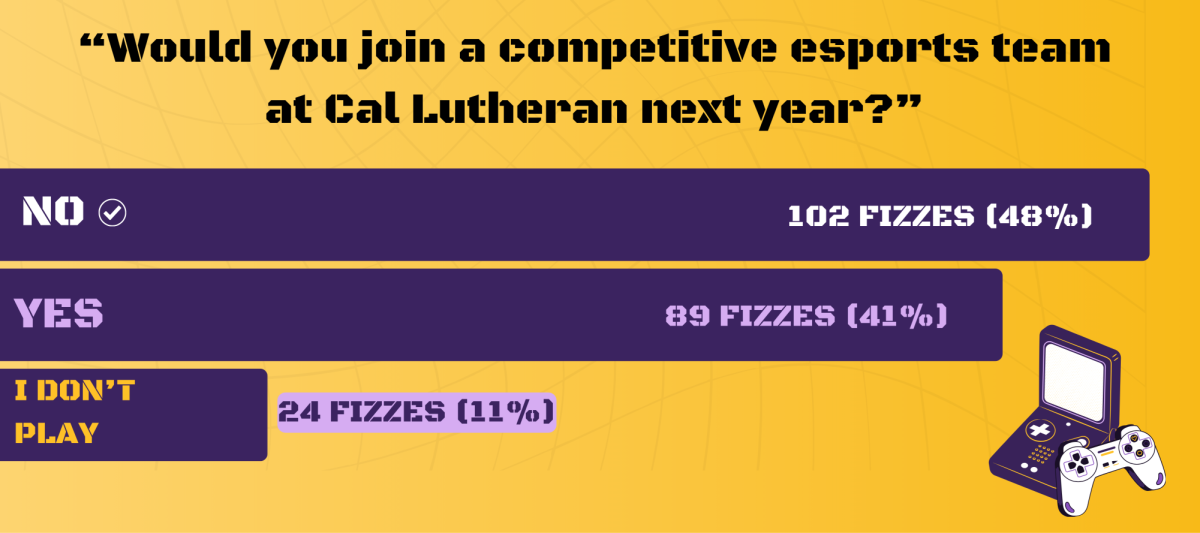
On Nov. 20, The Echo posted a survey to Fizz—an anonymous, campus-specific social media platform—asking students, “Would you join a competitive esports team at Cal Lutheran next year?”
The poll presented three options for respondents to answer: “Yes,” “No,” and “I don’t play video games.”
After 24 hours, there were 215 total responses – 89 (41%) voted yes, 102 (48%) voted no and 24 (11%) said they do not play video games.
At the Town Hall, Neilson said competitive video games can promote habits like teamwork and critical thinking.
Nunes said he was receptive to the program because it not only adds another facet to the Athletics Department, but it can also be mentally stimulating.
“If it is something with an educational value and something for which you can get academic kind of credit for it, for example, gaming theory and learning how to problem solve, then I am one hundred percent in favor,” Nunes said.
Nunes said esports can be a great way to create community.
“It has a global dimension to it as well,” Nunes said. “We need ways to bring people together, not separate people from each other.”


![“We heard [the students], and we’re going to try to offer something that still has their favorites, but also introduce something new at a point where people feel like they’re willing to pay,” Elizabeth Nepute said.](https://cluecho.com/wp-content/uploads/2026/04/IMG_9502-1200x800.jpg)