

An unauthorized individual covered a California Lutheran University senior’s painting while it was on display at the Kwan Fong Gallery of Art and Culture earlier this month, according to Associate Dean for the Creative and Performing Arts Michael Hart.
In an emailed statement to The Echo, Hart said the university is committed to academic and artistic freedom and opposes censorship in all of its forms. Hart did not identify who was responsible for the covering in his statement.
“The decision to cover the painting did not come from anyone with the authority to do so,” Hart said in the statement. “The situation was addressed and resolved quickly. The painting will not be covered in the future.”
The painting belongs to James Yocuté, a senior art major, who said he secured an exhibition in the Kwan Fong after he approached Jesse Groves, professor and curator of exhibitions and collections, and David Martin, assistant professor in the Visual Arts Department, for a venue that would accommodate more of his work and would be more accessible to students, given its location in the Soiland Humanities Center.
“The past four years at Cal Lu, I don’t think I had shown much work. I was always very insecure to create projects and, like, even think about putting my work out there,” Yocuté said.
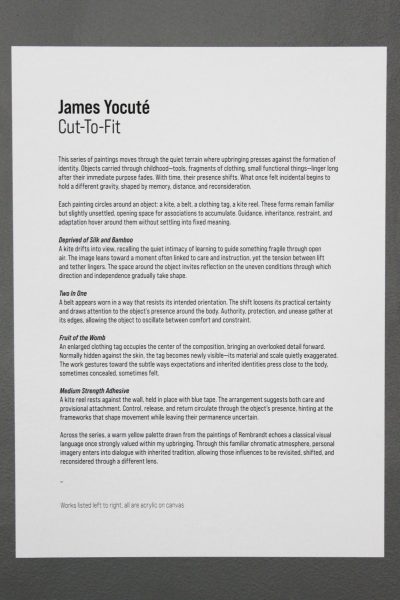
His exhibition went on display on Monday, March 9, and consists of two bodies of work: a street photography series and a four-painting series titled “Cut to Fit.” Yocuté said each canvas explores body dysmorphia, parental guidance and self identity through objects from his childhood.
“[Cut to Fit] is so abstract. You can have your assumptions about the work,” Yocuté said. “You might think it’s about textile waste and, like, maybe body dysmorphia on the slightest chance, but there was, like, a lot of room for creativity in your own assumption.”
Behind the Cloth
The covered painting, titled “Two in One” depicts a person wearing a belt fastened over a bare bottom, Yocuté said. In his artist statement, which was not up at the time of the covering, Yocuté said his work depicts how “authority, protection and unease gather at its edges, allowing the object to oscillate between comfort and constraint.”
On Saturday, March 14, the weekend that began spring break, Yocuté said he learned through word-of-mouth that “Two in One” had been covered by a black cloth. He said he immediately contacted Groves directly, who told him he was unaware of the situation and to document the incident through a formal email. When Yocuté returned, the painting was in its original state.
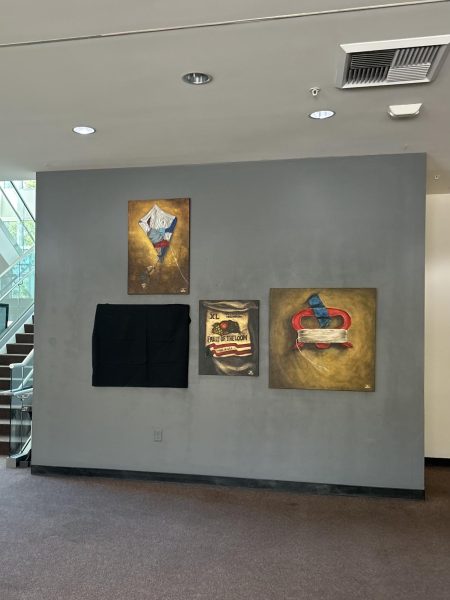
“I had gone back to take photos and somebody had removed it. I hadn’t removed it, and so there was kind of a mystery of who removed the cloth,” Yocuté said.
Yocuté said he was told the black cloth was cut to specifically fit the dimensions of his painting.
Yocuté said he was told that in the week leading up to the covering, Hart had held conversations with Groves and Martin about how “people felt strongly about the artwork.” Yocuté said Hart also had a gut instinct to check on the artwork, who too found it covered. Yocuté said he later received apologies via email from Hart and Martin.
Access to the Kwan Fong in the Soiland Humanities Center requires a Cal Lutheran ID card, as the building also hosts classrooms and faculty offices.
Yocuté said he believes the painting was covered out of concern that it was inappropriate for children attending Saturday classes in the center. Thousand Oaks Chinese School hosts classes in the building every Saturday from 9:15 a.m. to 12:30 p.m., according to previous coverage by The Echo.
“I think that looking at a human bottom is probably the funniest thing to a kid. That might be … the childish humor of life, and your adult mind just gets clouded and assumes it’s just an inappropriate piece,” Yocuté said. “It’s kind of weird if you think it’s a lot. Maybe you’re oversexualizing this, and maybe that’s where you become weird.”
After learning the interference was not authorized by Cal Lutheran, Yocuté said he characterized the act as vandalism rather than censorship.
“You do not interact with the gallery the same way you would not go up to Van Gogh’s painting … and put a covering over it because you feel uncomfortable. It is a form of vandalism,” Yocuté said.
Groves, who teaches the accompanying senior capstone course, addressed the incident in a written statement to The Echo via email.
“I care deeply, and hope we all do, that CLU remains a liberal arts community that invites ideas and embraces artists whose work offers different sensibilities—especially when it engages deeply held beliefs and lived experience,” Groves said. “To support the arts without censorship is to accept that we will encounter work that does not mirror our preferences; nor should it.”
Cal Lutheran’s Galleries and Exhibitions website lists the tips and policies for the Rolland Art Gallery and William Rolland Art Center, including that “artwork cannot be touched” and that “it is best to stand no closer than two feet from an artwork unless otherwise noted.” Grove said the general gallery rules extend to the Kwan Fong.
A Shared Space
The other artist featured in the exhibition, senior Bella Dinovitz, whose “Breath Break” series also hangs in the gallery, said she was not notified by the Visual Arts Department about the incident.
“No one reached out, actually, which I was kind of surprised about,” Dinovitz said. “There was no message or memo. I genuinely found out from James only.”
Dinovitz said her installation differs from Yocuté’s, as hers was designed for audience participation through an interactive corkboard where visitors can write their anxieties on flashcards and post them. She said she will intentionally leave all entries up as part of the piece, regardless of their content.
“He didn’t have the choice whether or not he wanted [the covering] to happen,” Dinovitz said. “He never said it was okay for anyone to touch it. No one should have touched his artwork because he didn’t say it was okay.”
Yocuté and Dinovitz said they were aware of a history of theft in the Kwan Fong prior to the exhibition.
According to David Hilke, director of Campus Safety, in May 2024, a ceramic bowl on display was taken by a student. After reviewing video footage, the student responsible was identified and the bowl was returned, Hilke said.
“Actual pieces of artwork have been stolen before. I did take that into account,” Dinovitz said. “That’s why for, like, the tin that I’m holding my pens in … I’d use, like, a coffee tin rather than an actual piece of ceramics I made. I had to, like, really, like, think about that through.”
According to Dinovitz, she and Yocuté, along with other seniors in the capstone course, signed a loan agreement with the university. She said the document outlined the university’s financial liability in the event that artwork on display is damaged or stolen.
“Let’s say, like, one of my frames falls off the wall and, like, shatters or something. We do have a set amount of money that they would have to pay us for our art being harmed,” Dinovotz said. “Groves, our capstone professor … was very, very, like, open about that and honest in saying, like, basically, like anything can happen in the gallery.”
Groves said the loan agreement is primarily used as a teaching tool for students to become familiar with professional practices and documentation but “does not anticipate or address intentional inference by CLU staff.”
“I do believe in freedom of voice, and James, through his art, is utilizing his voice by sharing a message with everyone,” Dinovitz said. “I just want people to really think about … empathy and compassion for others. How would you feel if your artwork had that happen to it?”
Yocuté said he is hoping to have a reception for his and Dinovitz’s exhibitions later in April and currently has a book with his street photography images in pre-press. He said he would like to speak to whoever is responsible one day to help them understand the piece.
“I don’t prey on anyone’s downfall. I would love to have a conversation with this person, sit them through the artwork, and talk to them about it,” Yocuté said. “I don’t hold anything against the school. I just would love faculty to maybe understand that these gallery spaces are gallery spaces.”


![“We heard [the students], and we’re going to try to offer something that still has their favorites, but also introduce something new at a point where people feel like they’re willing to pay,” Elizabeth Nepute said.](https://cluecho.com/wp-content/uploads/2026/04/IMG_9502-1200x800.jpg)